Saturday, 25 January 2014

An Example of an Actor Associated with a Thriller Film- Bruce Willis

  • Walter Bruce Willis was born on March 19th 1955 in West Germany to an American father, David Willis, and a German mother, Marlene, who worked in a bank. Bruce was the eldest of four children.
  • After being discharged from the military in 1957, David Willis took the family back to New Jersey and he worked as a welder and factory worker. A popular classmate, Willis was elected Student Council President and also threw himself into drama classes. This was perhaps because, tormented by a debilitating stutter, he discovered that he lost his impediment when on stage.
  • Rather than go to college after graduation, Willis farmed sheep in a mining village in Alabama but decided to quit after a colleague was killed on the job. After a stint as a bodyguard, Willis returned to his original passion of acting. He enrolled in a drama course at Montclair State University, where he was cast as Brick in the class production of Cat on a Hot Tin Roof. Having decided where his vocation lay, Willis decided to leave school to head to New York in pursuit of more lucrative acting parts.
  • Willis initially took work at CafĂ© Central as a way to meet celebrities and finally made his off-Broadway debut in 1977 in Heaven And Earth. He also took uncredited roles in The First Deadly Sin, Prince Of The City and The Verdict starring Paul Newman.
  • Slowly the acting dream began to transpire. Willis was a hit in Sam Shephard's theatre production of Fool For Love and managed to land a role as a wife-beating gun-runner in the massive hit show Miami Vice. Alongside acting roles, Willis also appeared in the first TV ad for Levi 501 Blues plus, with the then-unknown Sharon Stone plus another ad for Seagram’s wine coolers.
  • Now real stardom arrived, Willis flew to LA to audition for a part in Desperately Seeking Susan, but was rejected. While he was in town he found out what other auditions were taking place - one of which was for a new ABC show to be named Moonlighting. Willis found himself up against 3,000 other hopefuls in the race to star alongside Cybil Shepherd as the smooth, wisecracking David Addison. He managed to win over the producer, who cast him despite protests from ABC who would have preferred a well-known actor in the lead role.
  • Moonlighting ran from 1985 to 1989 and was an enormous success, but Willis soon got a hunger for roles beyond the world of TV. Off the back of Moonlighting, Willis starred in two films by Blake Edwards - Blind Date with Kim Basinger and Sunset - both of which were flops.
  • 1987 was to be Willis’s year though. Firstly, Willis met his future wife, Demi Moore, at the premiere of Stakeout, and also became an unlikely international singing star with the hit record The Return Of Bruno, a collection of Motown-type material, including a cover of Respect Yourself. This was followed by a second album, If It Don't Kill You, It Just Makes You Stronger.
  • Willis won an Emmy and a Golden Globe for Moonlighting the same year. But the real breakthrough came when Willis took the part of Detective John McClane in the film Die Hard. The film was a word-of-mouth smash that took everyone by surprise with Willis redefining the role of the action hero.
  • Willis then hit big again in 1989, this time providing the voice of baby Mikey in the comedy Look Who's Talking. More box office hits followed with the sequels to Die Hard and Look Who's Talking, but then Willis's career encountered a rollercoaster period.
  • Willis’s next project was starring alongside Tom Hanks in Brian De Palma's adaptation of Bonfire Of The Vanities (1990), which sadly bombed with both the critics and consumer audience. Quickly Willis redeemed himself with The Last Boy Scout (1991), but then took another nosedive in Hudson Hawk (1991) which once again drew embarrassing box office takings.
  • Willis’s career continued on an uninspiring plateau with the minor hit comedy Death Becomes Her (1992), the enjoyable but mostly ignored Striking Distance (1993), and an uncredited role in Loaded Weapon (1993). But the intervention of cult Director Quentin Tarantino in offering Willis a part in Pulp Fiction (1994) earned him rave reviews and finally, Willis was back on track.
  • Rather than sit back and be content, Willis next played a man in a pink bunny-suit in Rob Reiner's North, appeared alongside Paul Newman again in the low-key Nobody's Fool, both in 1994.
  • Success continued in 1995 with Terry Gilliam's tremendous 12 Monkeys, and once more in Die Hard III. A series of mediocre flicks in 1997 and 1998 saw Willis star in the films The Jackal, The Siege and Mercury Rising, and the superficial sci-fi oddity The Fifth Element.
  • Willis took the lead in Armageddon in 1998, which went on to be a $200 million box office hit. He continued his hiatus starring in the supernatural thriller The Sixth Sense, which broke Armageddon’s box office results and was an instant success.
  • A debut in Friends as Jennifer Anniston’s boyfriend led not only to a second Emmy win for Outstanding Guest Actor but also to a role alongside Matthew Perry in The Whole Nine Yards (2000), in which Willis donated his fee to various charities.
  • The same year brought another massive screen hit for Willis with Unbreakable, working once more with Sixth Sense director M. Night Shalamayan.
  • While Willis’s career was undoubtedly at an all-time high, his personal life was sadly working in retrograde. After a 12 year marriage and three daughters, Willis separated from Demi Moore in 2000. The year was also tarnished by Willis losing his position as Seagrams spokesman after being caught drink driving. And then there was Planet Hollywood, which filed for bankruptcy, closed numerous branches and submitted to a major restructuring.
  • Returning back to music, Willis toured Europe to try and revive interest in the Planet Hollywood chain again. Attempting to spread his wings even further, Willis followed the worldwide success of Unbreakable with a string of more testing projects. A return to comedy alongside Billy Bob Thornton and Cate Blanchett in the film Bandits (2001) was followed by an appearance in a filmed stage version of Sam Shephard's True West recorded at the Liberty Theatre in Idaho, then the war film, Tears Of The Sun (2003).
  • Willis took just one film part in 2004 when he reprised his role as Jimmy The Tulip in a sequel to The Whole Nine Yards (The Whole Ten Yards). 2005 would see a string of new releases (as well as a tour of musical dates in Las Vegas). First came Hostage, which also saw the debut of Willis's daughter, Rumer.
  • Next was a role starring in Robert Rodriguez's visually-stunning Sin City, based on the graphic novels of Frank Miller. This was set in a seedy, violent noir-world. Willis next moved on to Alpha Dog (2006), written and directed by Nick Cassavetes and based on the real-life story of Jesse James Hollywood.
  • Another film noir in Lucky Number Sleven (2006) followed recently and Willis replaced Jim Carrey as the voice of a con-artist raccoon in the animation Over The Hedge- proof of his penchant for accepting a mixed bag of opposing parts. After nearly 20 years of fame, Bruce Willis remains at the top of the A-list and still going strong.
Thriller Films that he has been in include:
-The First Deadly Sin
-The Die Hard series (John McClane)
-Mortal Thoughts (James Urbanski)
-Billy Bathgate (Bo Weinberg)
-Pulp Fiction (Butch Coolidge)


    The Trailer for his most well known film, Die Hard      


http://en.wikipedia.org/wiki/Bruce_Willis_filmography#Film
http://www.thebiographychannel.co.uk/biographies/bruce-willis.html

Martin Scorsese-A Director who is Associated with the Thriller Genre

  • Scorsese's movies are often rooted in his own Italian-American heritage, with its social codes and violence.
  • When he first started out, Scorsese began to collaborate with Harvey Keitel, a then theatre actor. 'Who's That Knocking at My Door?' starred Keitel. The film had problems finding a distributor until Scorsese agreed to add a gratuitous sex scene, and it was released in 1969. 
  • 1972's 'Boxcar Bertha', was another early movie of note
  • Scorsese's legend as we know it was born with 1973's 'Mean Streets'. The star-director pairing with De Niro would be one of the most influential in film.
  • The following year, Scorsese made 'Alice Doesn't Live Here Any More', which won Ellen Burstyn a best actress Oscar.  
  • 1976 saw the release of one of the century's seminal movies, 'Taxi Driver'. De Niro starred as Travis Bickle, a disturbed Vietnam veteran and taxi driver, opposite Jodie Foster's teenage prostitute in need of redemption. Taxi Driver's highly violent finale was unprecedented and controversial, and would influence future directors including Quentin Tarantino. Scorsese appeared in the movie as a homicidal passenger.
  • Next, De Niro was paired with Liza Minnelli – an extra-marital love interest of Scorsese's – in a dark musical. 'New York New York' was a flop in 1977, but the director returned to form in 1980 with his masterpiece 'Raging Bull', again starring De Niro.
  • Based on the autobiography of boxer Jake La Motta, the script afforded Robert De Niro the role of his career. 'Raging Bull' brought Scorsese his first Oscar nod for best director, as well as another seven Academy Award nominations including best picture and best actor. Only De Niro and editor Schoonmaker
    took home statues.
  • Buoyed by the success of 'Raging Bull', Scorsese attempted to fulfill a long-held ambition and make a Christ biopic, but was thwarted by the studio's reluctance to fund him. His personal life wasn't faring much better.
  •  After another De Niro collaboration, 'The King of Comedy', he made a pool hustler drama 'The Color of Money', starring Tom Cruise and Paul Newman. Scorsese's new wife, Barbara De Fina, was the producer. The movie was a hit with five Oscar nominations and Paul Newman winning best actor.
  • Funded and finished at last, 'The Last Temptation of Christ' finally hit the silver screen in 1988, at which time Scorsese was accused of blasphemy by the church and few of his 'Raging Bull' fans were captivated. Still, he had finally crossed the ultimate biopic off his list.
  • Despite a mixed reception to 'Last Temptation', it was becoming clear that the director's career was to be one of extraordinary longevity and consistent quality. In a 1990 return to more familiar subject matter, he released the hugely popular Italian-American gangster flick 'GoodFellas'. De Niro was cast alongside Ray Liotta in this supremely violent movie. It a was a career high that brought another best director nomination.
  • The following year's 'Cape Fear' would be the most commercially successful film of the Scorsese's career to date. De Niro won a best actor Oscar for the 'Cape Fear' role in 1992.
  • The De Fina marriage had ended in 1991 and as the '90s progressed, Scorsese's output defied easy categorisation. 'The Age of Innocence',seemed an unlikely offering, but earned respectful reviews. The mobster tale 'Casino', meanwhile, failed to have the impact of 'GoodFellas'. He next turned his attentions to another unlikely subject, the Dalai Lama. 'Kundun' (1997) was a visual and aural feast but, following on the heels of another similar-themed feature, (the Brad Pitt vehicle, 'Seven Years in Tibet'), it struggled at the box office, despite critical kudos. Scorsese met his fifth wife Helen Morris when she was editing the companion book to 'Kundun'.
  • In the next decade, Scorsese returned to the subject of immigrant gangs with a twist. The epic 'Gangs of New York', about Irish immigrants to New York in the 19th century, was a box office smash and the first of a series of collaborations with actor Leonardo DiCaprio. Cameron Diaz and Daniel Day-Lewis also starred, and the film received 10 Oscar nominations, including Scorsese's fifth for best director.
  • DiCaprio and Scorsese triumphed again with 'The Aviator', 2004's well-received Howard Hughes biopic. New talents portrayed Old Hollywood, including Cate Blanchett as Kate Hepburn and Jude Law as Eroll Flynn.
  • Scorsese's next release, the documentary, "Bob Dylan: No Direction Home' (2005), reminded the world he was an avid music fan as well as a director. Dylan and The Band had been the subject of his documentary 'The Last Waltz' in 1978.
  • DiCaprio starred again in 'The Departed', an Irish-American crime story set in South Boston. It was for The Departed that Scorsese finally won a best director Oscar. He had been nominated for the Academy Award on five previous occasions, and twice for best screenplay. As he received his first Oscar, Scorsese, who attended the ceremony with his wife Helen, joked: "Could you double-check the envelope?"
  • In 2008, he returned to music documentary when he directed 'Shine a Light', which is a film depicting a concert by the Rolling Stones performed at New York City's Beacon Theatre in 2006. It also contains brief news and interviews from throughout the band's career. The world premiere of the film was at the 58th Berlinale Film Festival on 7 February 2008.
  • The director once again collaborated with Di Caprio for the 2010 film 'Shutter Island' which starred the actor as a detective sent to investigate a disappearance from a mental asylum. It also starred Mark Ruffalo, Ben Kingsley and Michelle Williams. On 20 May 2010, Shutter Island was Scorsese's highest-grossing film.
  • He then delved into the world of TV, directing the pilot episode of 'Boardwalk Empire', which made its debut on 19 September 2010. It has just been recommissioned for a second series, of which Scorsese will be executive producer.
http://www.thebiographychannel.co.uk/biographies/martin-scorsese.html


Taxi Driver ^

Quentin Tarantino- A Director who is Associated with the Thriller Genre


  • Having famously learned his art while working as a video store clerk after dropping out of high school, Tarantino burst onto the scene first as a writer, penning the original drafts of Tony Scott's "True Romance" (1993) and Oliver Stone's "Natural Born Killers" (1994). 
  • Although famous as a director, Tarantino had aspirations of being an actor too, so placed himself in a leading role for "My Best Friend's Birthday." He also made a blink-and-you'll-miss-it appearance as one of several Elvis impersonators in a 1988 episode of "The Golden Girls" (NBC, 1985-1992). With little money in his pocket, 
  • Tarantino and Avery were hired by producer John Langley, a regular video store customer who was impressed by their film knowledge, to work as production assistants on a Dolph Lundgren exercise video. 
  • This led to work at Cinetel Productions, where Tarantino and Avary hooked up with producer Lawrence Bender and finished the screenplay for "Reservoir Dogs," a brutally violent, yet elegantly written crime drama about the aftermath of a jewelry store heist gone bad. Originally budgeted for $35,000, the production grew to $1.5 million when Harvey Keitel - who played the morally-conflicted Mr. White - became enamored of the script and agreed to star. 
  • The result was a cleverly structured and stylized caper with themes of masculinity, loyalty and betrayal that benefited greatly from top notch tough-guy performances from a superior ensemble. The soundtrack for the film were songs that meant something personal to Tarantino 
  • "Reservoir Dogs" premiered at the 1992 Sundance Film Festival, but was pointedly snubbed by the jury. Nonetheless, Tarantino became an overnight sensation and found himself to be in high demand in Hollywood. 
  • Two scripts he co-wrote with Avary - though it remained in dispute how much credit went to his writing partner - were immediately snatched up and turned into films. The first, was "True Romance" (1993) and the second was "Natural Born Killers" (1994), 
  • Tarantino escaped to Amsterdam, where he took in the local wares and penned the drafts for what became both his signature film and a pop culture phenomenon, "Pulp Fiction" (1994). Returning to a familiar urban landscape characterized by themes of trust and betrayal, and inhabited by gangsters given to low-level postulating, "Pulp Fiction" boasted another A-list cast including Bruce Willis, John Travolta, Samuel L. Jackson, Uma Thurman and Christopher Walken. While earning several Academy Award nominations and a win for Best Original Screenplay. Many felt for some time that "Pulp Fiction" was robbed of the Best Picture win, losing instead to the feel-good Robert Zemeckis film, "Forrest Gump" (1994).
  • Quite literally, "Pulp Fiction" made Tarantino the toast of Hollywood overnight. After taking home well over a dozen major awards for "Pulp Fiction," Tarantino was all but omnipresent in late 1994 and 1995. As an actor, he had began popping up in small roles in independent features.
  •  Segueing to television, Tarantino had a guest shot on Margaret Cho's short-lived sitcom "All-American Girl" (ABC, 1994-95) and directed a flashy installment of the medical drama "ER" (NBC, 1994-2009). 
  • A few years later, Tarantino was to direct an installment of the popular sci-fi series "The X-Files" (Fox, 1993-2002) but he had refused to join the Directors Guild of America and was unable to secure a waiver to helm the episode.
  • Tarantino and Bender expanded their production company, A Band Apart, formed in 1991. The latter was a specialty distribution label under Miramax Pictures designed to acquire, distribute and market four films per year. The emphasis was supposed to be on
    visceral, exploitation-tinged genre movies.
  • As a filmmaker, Tarantino returned to the screen to executive produce "Four Rooms" (1995), a poorly received comedy anthology, for which he also wrote, directed and starred in the worst of four segments involving the comic antics of a frazzled hotel concierge (Tim Roth).
  • He fared better as executive producer, writer and co-star of Rodriguez's "From Dusk Till Dawn" (1996), but box office take was brisk. Still in demand as an actor, Tarantino played an unsympathetic version of himself as "QT" in Spike Lee's sex comedy, "Girl 6" (1996).
  • For his long-awaited follow-up feature, Tarantino adapted Elmore Leonard's novel Rum Punch into "Jackie Brown" (1997), a vehicle for blaxploitation actress Pam Grier. 
  • Fans expecting "Pulp Fiction 2" were somewhat disappointed. While some critics carped over the film's length, many were enthralled with the script and the casting. 
  • Other than an acting appearance on stage in "Wait Until Dark" (1998) and a small role in the tepid Adam Sandler comedy "Little Nicky" (2000), Tarantino took a long hiatus from public appearances and filmmaking amid tabloid headlines proclaiming rumors of writer's block, pot smoking, temper tantrums and fistfights; rumors he denied. 
  • Tarantino spent three years writing a World War II epic called "Inglourious Basterds," but he failed at the time to find the right ending.
  • Finally settled on directing "Kill Bill," an unabashedly bloody valentine to kung fu and blaxploitation films. 
  • Initially set as a $42 million movie, "Kill Bill" ballooned into a $60-plus million, three-hour opus that took 155 days to shoot. But Tarantino kept forging forward until the film was finished. Miramax was impressed with the quality of the footage, yet unsure of an audience's ability to endure unrelenting levels of violence. In a shrewd move, Tarantino decided to issue the film in two segments just months apart - "Kill Bill, Vol. 1" (2003) and "Kill Bill, Vol. 2" (2004). One of the most graphically violent films ever released - with an R rating, no less - "Kill Bill, Vol. 1" proved to be every bit as critically polarizing as any Tarantino effort, with many critics calling it brilliant cinema and others decrying its gut-wrenching scenes. Like other Tarantino efforts, "Kill Bill, Vol. 2" spun the already established formula on its head when it scaled down the action in favor of unexpected character moments and the writer-director's characteristically absorbing dialogue - not to mention demonstrating his gift for luring top-notch performances out of actors whose careers had dimmed.
  • Tarantino next appeared as a "special guest director" in director Robert Rodriguez and writer-artist Frank Miller's adaptation of Miller's crime noir comic book series "Sin City" (2005). 
  • Tarantino helmed the tense, eerie sequence within "The Big Fat Kill" storyline.
  • Tarantino stepped behind the camera to direct the 2005 season finale of "CSI: Crime Scene Investigation" (CBS, 2000- ). 
  • After scoring an Emmy nomination his "CSI" stint, Tarantino expressed interest in assembling a limited-run series "like one big arc-novel," but nothing came of the idea. 
  • Tarantino next teamed up with directing pal Robert Rodriguez once more to direct "Grindhouse" (2007). Tarantino's offering was a slasher-cum-road rage flick called "Death Proof". Despite widespread attention lavished on the film, it failed to draw large crowds to theaters. 
  • Meanwhile, Tarantino finally found the ending he was looking for with "Inglourious Basterds" and went about putting it together for his next film. After a leaked copy of the script made the Internet rounds, Tarantino quickly went about casting actors. It brought Tarantino his best critical acclaim since "Pulp Fiction." He earned Golden Globe nominations for Best Director and Best Screenplay; a DGA Award nomination for Outstanding Directorial Achievement in Feature Film. More importantly, the film earned a total of eight Academy Award nods including for Best Picture, Best Director and Best Original Screenplay.
  • Two years later, Tarantino went to work on his next film, "Django Unchained" (2012). All the requisite hype - particularly on the Internet - was in full effect during the film's production. Before the film was even released, Tarantino received both a Golden Globe and an Oscar for Best (Original) Screenplay.
http://uk.movies.yahoo.com/person/quentin-tarantino/biography.html


Pulp Fiction (1994) Trailer, one of his most famous films ^

Friday, 24 January 2014

Steven Spielberg- A Director who is Associated with the Thriller Genre

  • Born to parents Arnold and Leahanni Spielberg. The older brother to three younger sisters, Spielberg began experimenting with film in his early teens making movies he would show at his family house.
  • At 13, Spielberg was already showing glimpses of future greatness, even winning a prize for his 40-minute war film 'Escape to Nowhere'.
  • Family often moved with his father's job and it was at Arcadia High School in Phoenix, Arizona that he produced his first feature-length film, 'Firelight', a science fiction movie with a budget of $400. Foreshadowing his future success, the film turned a tidy $100 profit after it was shown at a local theatre.
  • After his parents divorced, Spielberg moved to California with his father. He repeatedly applied to the UCLA School of Theatre, Film and Television and the University of Southern California's School of Cinema and Television but failed to gain entry. He attended California State University, Long Beach and got his first job in the film industry as an unpaid intern in the editing department of Universal Studios.
  • The job at Universal came almost by accident as he jumped from a tour bus and ventured inside one of the buildings on the studio grounds. His enthusiasm made such an impression on one of the workers, they gave him a pass to come back and watch directors at work. Spielberg made a point of being friendly with the security guards on the lot and on the fourth day he just waved rather than displaying his pass.
  • It was during this time he made his first professional release: a 24-minute film called 'Amblin'. The film, about a boy and girl who meet hitch-hiking to a beach, would later lend its title to Spielberg's production company. Executives at Universal were so impressed they signed Spielberg as a television director. He dropped out of college to take the job in 1969 and did not finish his degree until 33 years later in 2002.
  • Spielberg's first forays into professional directing came in television working on shows such as 'Night Gallery', 'Name of the Game', 'Marcus Welby M.D.', 'Owen Marshall', and 'Columbo'. His first movie was a made-for-TV film called 'Duel about a giant truck that menaced a man driving a smaller car through desert roads that would become a recurring sight in his later works.
  • Spielberg claims to enjoy the theme of menacing, saying it appeals to the primal fears of the audience.
  • Spielberg's debut into full-length theatrical releases came with 1974's 'Sugarland Express' with a young Goldie Hawn. Though the film
    did poorly at the box office, Spielberg was marked by critics and industry executives as a potential star.
  • The film that set the Spielberg juggernaut in action was the 1975 hit 'Jaws'. The horror film about a giant killer shark with its iconic atmospheric music won three Academy Awards for editing, original score, and sound, and was nominated for Best Picture losing out to 'One Flew Over the Cuckoo's Nest'. 'Jaws' set box office records grossing over US$100 million and made Spielberg a millionaire in his early 30s.
  • His next film, 'Close Encounters of the Third Kind', cemented Spielberg's rise. The science fiction film starring 'Jaws' actor Richard Dreyfuss was written and directed by Spielberg and garnered six Academy Award nominations, including Best Director. It won two awards for Cinematography and a Special Achievement Award for Sound Effects Editing.
  • The war farce '1941' had the distinction of being Spielberg's first flop, with critics and audiences alike but this was quickly followed by a string of action-adventure blockbusters in the early 1980s. The adventure movie 'Raiders of the Lost Ark' with friend and 'Star Wars' creator George Lucas was the biggest movie of 1981 and gained Spielberg his second Best Director nomination.
  • In 1983, Spielberg released 'E.T. the Extra-Terrestrial'. The film about a small boy befriending and saving an alien became the highest-grossing film in history and was nominated for nine Academy Awards. A second 'Indiana Jones' film, 'Indiana Jones and the Temple of Doom' was followed by 'Poltergeist', 'The Twilight Zone', and 'The Goonies', all recording impressive returns at the box office.
  • Two years later, Spielberg made his first foray into drama with 'The Colour Purple' (1985). The film, about a group of Depression-era African-American women, was a massive hit with critics and crowds and earned 11 Oscar nominations. It seemed Spielberg could do no wrong.
  • His next film 'Empire of the Sun', a drama about an English boy separated from his parents in war-torn China, received critical acclaim but did not fare so well at the box office.
  • The 'Indiana Jones' franchise was revived in 1989 with 'Indiana Jones and the Last Crusade', this time adding Sean Connery to the mix as Jones senior alongside Harrison Ford
  • Despite dominating Hollywood for over 15 years, Spielberg did not receive his first Best Director Academy Award until 1993's 'Schindler's List'. Starring Liam Neeson, the film told the story of Oskar Schindler, a German industrialist who helped over 1,000 Jews escape death during the Holocaust. Though a box office and critical smash, Spielberg did not receive payment for the film, instead preferring his profit to go to setting up the Survivors of the Shoah Visual History Foundation which chronicles and stores the testimony of Holocaust survivors.
  • Spielberg took a break from directing in the mid-1990s to set up his own film studio 'DreamWorks'. He returned in 1997 with the sequel to 'Jurassic Park: The Lost World' and then 'Amistad', a movie about a rebellion on a slave ship.
  • DreamWorks' first hit was the Spielberg-directed World War Two film 'Saving Private Ryan', which was about a group of soldiers trying to find their missing comrade in war-torn France. 'Saving Private Ryan' was followed in 2001 by 'A.I'., a sci-fi film started but left uncompleted by legendary director Stanley Kubrick after he died. Another science fiction film followed with 2002's 'Minority Report' based on a Philip K Dick novel and starring Tom Cruise.
  • The blockbusters kept rolling on with 'Catch Me If You Can' in 2002 and 'The Terminal' in 2004. Another sci-fi film saw Spielberg again collaborating with George Lucas and Tom Cruise in 'War of the Worlds' in 2005.
  • Complementing a long and distinguished career as a director, Spielberg has also produced many films and TV shows. He produced the TV Show 'ER' for a time and also helmed 'SeaQuest DSV'. He was the producer on the cartoons 'Tiny Toon Adventures', 'Animaniacs, Pinky and the Brain', 'Toonsylvania' and 'Freakazoid!'.
  • Movies he has produced include 'Back To The Future', 'An American Tail', 'Mask of Zorro', 'Men In Black', 'Deep Impact', 'Memoirs of a Geisha', and Clint Eastwood's 'Flags of Our Fathers' and 'Letters from Iwo Jima'. He executive produced 'The Haunting', 'Shrek', 'Monster House', 'Evolution', and 'Disturbia'.
  • Spielberg's films have often been criticised for staying too close to the mainstream but his knack for story-telling and his ability to produce crowd-pleasers is unequalled in movie history. His films normally pack in adventure, emotion, mystery, and scale as encapsulated in his quote about his film making process: "Before I go off and direct a movie, I always look at four films. They tend to be The Seven Samurai, Lawrence Of Arabia, It's A Wonderful Life and The Searchers".
  • In 1985, Spielberg married actress Amy Irving and the couple had a son, Max. The couple divorced in 1989 and Spielberg married actress Kate Capshaw who was in 'Indiana Jones and the Temple of Doom'. They have four children: Theo, Sasha, Sawyer and Destry - Capshaw has a daughter, Jessica, from a previous marriage. They also have two adopted children, Mikaela and Theo, and Spielberg's god-daughter Janet also lives with them.
  • 2006 saw Spielberg named as the most powerful person in movies by film magazine Premiere. Time magazine listed him in its 100 Greatest People of the Century and Life magazine named him the most influential person of his generation.
  • He has won three Academy Awards and in 2001, he was made a Knight Commander of the Order of the British Empire. His fortune is estimated to be in excess of US $3 billion.

http://www.thebiographychannel.co.uk/biographies/steven-spielberg.html


Jaws, Blood on the Beach -------------------------------------------->

Alfred Hitchcock- A Director who is Associated with the Thriller Genre


  • Born on 13 August 1899 in Leytonstone, London to greengrocer William Hitchcock and his wife Emma. 
  • Raised a strict catholic and was educated at Saint Ignatius College, which was run by Jesuits.
  • His first job outside of his father's business was as an estimator for the Henley Telegraph and Cable Company, which he started in 1915. At this age is when his love for films developed as he went to the cinema in his spare time.
  • Hitchcock entered the world of film as soon as he finished university. He started as a draftsman for a film studio, which was built in London in 1920 and quickly worked his way up to scriptwriter, then art director and assistant director, until his debut film as a director in 1925.              
  • He had previously had experience of directing when he was asked to complete the 1923 film 'Always Tell Your Wife' after the original director fell ill. He was then asked to direct 'Number 13' but before it could be finished the studio closed its London branch. Instead his directorial debut was 'The Pleasure Garden' in 1925.
  • It was with the film 'The Lodger', in 1927, that Hitchcock had his first hit, and was widely noticed as a director. In 1929, Hitchcock directed 'Blackmail', which was groundbreaking in its success as the first widely popular non-silent film.
  • Hitchcock's reputation in Britain was consolidated with his hits such as 'The Man Who Knew Too Much' (1934), 'The 39 Steps' (1935) and 'The Lady Vanishes' (1938).
  • These films brought international notice and, in 1939, Hitchcock moved across the Atlantic, which marked a critical point in his career.
  • Hitchcock's American debut film, 'Rebecca' (1940), starred Laurence Olivier and Joan Fontaine and was a huge success, winning an Oscar for Best Picture. This film was based on the gothic novel by Daphne Du Maurier.
  • Success followed success for Hitchcock, with a number of hits, perhaps the most famous being 'Notorious' (1946), 'Rear Window' (1954), 'Vertigo' (1958), 'North by Northwest' (1959) and, of course, 'Psycho' (1960).
  • Other notable films over his 50-year career included 'Dial M For Murder' (1954), 'To Catch A Thief' (1955), 'Birds' (1963) and 'Torn Curtain' in 1965. His final film was 'Family Plot' in 1976.
  • Hitchcock's success earned him both followers as well as critics. Some of his critics argued his films lacked substance but his admirers argued that the truth was the opposite and instead Hitchcock was "an all-round specialist".
  • Hitchcock's style was one of meticulous planning, from which it is reported that he never improvised or deviated. He also adhered to his own maxim on the value of suspense over shock.
  • This appreciation of planning could help explain why he liked to use the same actors regularly. Although he apparently disliked most actors and their behaviour, perhaps his regular use of a select few can be put down to the fact that there were only a few actors Hitchcock actually liked or admired.
  • His 'select few' included Cary Grant, James Stewart, Vera Miles, and Grace Kelly. The 'actor' that appeared in almost all of his films was, however, himself, as he nearly always gave himself a cameo in each of his films.
  • Surprisingly, despite being nominated on several occasions, Hitchcock never won an Oscar for Best Director, although he did pick up Best Picture in 1940 for 'Rebecca'.
  • In 1979, Hitchcock was recognised by the British establishment and was knighted by the Queen.
  • Hitchcock was married in 1926 to Alma Reville, a film editor. They had a daughter, Patricia Hitchcock, who appeared in some of Hitchcock's most famous films.
  • On 29 April, 1980, Hitchcock died at the age of 80. 
http://www.thebiographychannel.co.uk/biographies/alfred-hitchcock.html

Psycho Shower Scene ------>  

What is a typical story and setting of a Thriller?

The main character of these films is set against a problem – an escape, a mission, or a mystery. No matter what sub-genre a thriller film falls into, it will emphasise the danger that they face. The cover-up of important information from the viewer, and fight and chase scenes are common in all of the thriller subgenres, even though each subgenre has its own unique characteristics and methods.
Plots of thrillers include characters which come into conflict with each other or with outside forces – the threat is sometimes abstract or unseen. An atmosphere of creepy menace and sudden violence, such as crime and murder, characterise thrillers. Thrillers often present the world and society as dark, corrupt, and dangerous, but in Hollywood, they usually feature upbeat endings in which evil is overcome. The tension usually arises when the character is placed in a menacing situation, a mystery, or a trap from which escaping seems impossible. Life is threatened, usually because the principal character is unsuspectingly or unknowingly involved in a dangerous or potentially deadly situation.
Thrillers emphasise the puzzle aspect of the plot. There are clues, and the viewer should be able to work out the solution at about the same times as the protagonist. In thrillers, the compelling questions isn’t necessarily who did it, but whether the villain will be caught before committing another crime. Hitchcock's films often placed an innocent victim (an average, responsible person) into a strange, life-threatening or terrorising situation, in a case of mistaken identity, misidentification or wrongful accusation.
Thrillers take place mostly in ordinary suburbs and cities, although sometimes they may take place wholly or partly in exotic settings such as foreign cities, deserts,polar regions, or the high seas. These usually tough, resourceful, but essentially ordinary heroes are pitted against villains determined to destroy them, their country, or the stability of the free world. Often in a thriller, the protagonist is faced with what seem to be overwhelming problems in his mission, carried out against a ticking clock, the stakes are high and although resourceful, they face personal dilemmas along the way forcing them to make sacrifices for others.

 http://en.wikipedia.org/wiki/Thriller_%28genre%29#Story_and_setting 

Wednesday, 15 January 2014

Sub-Genres of a Thriller

Before I researched what a thriller was, I thought it was just a movie that includes anticipation and suspence. I had no idea that there were loads of sub-genres within it: 


Action Thriller

An Action Thriller uses lots of physical action to create suspense within the film. Like a traditional Action film, they will often have continuous motion and action including physical stunts, chases, fights, battles, and races. Often, these scenes will contribute to the overall sense of danger that the main character is facing.


An example of an Action Thriller is 'Die Hard', where a New York City cop gets trapped in a Los Angeles high-rise occupied by terrorists on Christmas Eve.


  • http://www.movietickets.com/movie/mid/11548/n/Die-Hard


  • Crime Thriller

  • Crime Thriller film is a sub-genre that combines the suspenseful aspects of a thriller with a crime film plot. This sub-genre's plot usually focuses on a serial killer, murderer, robbery, or manhunt. In contrast to traditional crime films, the storyline focuses around the criminal and the protagonist. Crime Thrillers use action and psychological aspects to build tension and suspense.


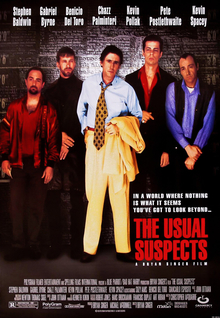
  • An example of a Crime Thriller is 'The Usual Suspects', where police investigating an exploded boat on a San Pedro pier discover 27 bodies and $91 million worth of drug money. The only survivors are a severely burned Hungarian terrorist and Verbal Kint, a crippled con-man.  Kint is pressured into explaining exactly what happened on the boat. His story begins six weeks earlier with five criminals being dragged in by New York police desperate for suspects on a hijacked truck and ends with the possible identification of a criminal mastermind.

  • http://www.imdb.com/title/tt0114814/plotsummary


  • Psychological Thriller
  • A Psychological Thriller incorporates elements of drama and mystery film in with the traits of a regular Thriller. The suspense in this sub-genre comes from the mind, rather than from a psychical threat. The main characters in Psychological Thrillers must rely on their mental resources to solve the situation. Because of their nature, many Psychological Thrillers cross over into the Horror genre.
  • An example of a Psychological Thriller is 'Taxi Driver'. Travis Bickle is an ex-Marine and Vietnam War veteran living in New York City. As he suffers from insomnia, he spends his time working as a taxi driver at night, watching porn movies at seedy cinemas during the day, or thinking about how the world, New York in particular, has deteriorated into a cesspool. He's a loner who has strong opinions about what is right and wrong with mankind. For him, the one bright spot in New York humanity is Betsy, a worker on the presidential nomination campaign of Senator Charles Palantine. He becomes obsessed with her. After an incident with her, he believes he has to do whatever he needs to make the world a better place in his opinion. One of his priorities is to be the savior for Iris, a twelve-year-old runaway and prostitute who he believes wants out of the profession and under the thumb of her pimp and lover Matthew.

  • http://www.imdb.com/title/tt0114814/plotsummary


  • Science Fiction Thriller

  • Science Fiction Thriller include hypothetical, science-based themes into the plot of the film. Traditionally, a Science Fiction film will include heroes, villains, unexplored locations, fantastical quests, and advanced technology. These elements can be used in a Science Fiction Thriller to create anticipation and suspense. Often, this sub-genre will explore the “future-gone-bad” theme, including plots that revolve around alien invasions, dystopian scenarios, and super-diseases.
  • An example of a Science Fiction Thriller is 'District 9'. In 1982, a massive star ship bearing a bedraggled alien population, nicknamed "The Prawns," appeared over Johannesburg, South Africa. Twenty-eight years later, the initial welcome by the human population has faded. The refugee camp where the aliens were located has deteriorated into a militarized ghetto called District 9, where they are confined and exploited in squalor. In 2010, the munitions corporation, Multi-National United, is contracted to forcibly evict the population with operative Wikus van der Merwe in charge. In this operation, Wikus is exposed to a strange alien chemical and must rely on the help of his only two new 'Prawn' friends.

  • http://www.imdb.com/title/tt1136608/


  • Religious Thriller
    Religious Thriller film incorporates religious themes, including religious questions, ceremonies, and objects. Though some films can revolve around a specific church, many Religious Thrillers include supernatural experiences not pertaining to a certain religion. Exorcisms, demon possession, and church cover-ups are typical themes of Religious Thrillers.


  • An example of a Religious Thriller is 'Devils Advocate'  where a young, seemingly unbeatable lawyer from a small town in Florida. When he gets an offer to go to New York and work for a large firm, him and his wife Mary Anne jump at the opportunity. Soon, Mary Anne begins to dislike the city and Kevin's job. She urges him to quit and go back to Florida but he sees her as insane. The longer he works however, the more his wife makes sense, but is it too late?


  • http://www.imdb.com/title/tt0118971/plotsummary


  • Conspiracy Thriller

  • A thriller in which the hero/heroine confronts a large, powerful group of enemies whose true extent only he/she recognises. 


  • An example of a Conspiracy Thriller is 'Snake Eyes'. In an Atlantic City casino, an important boxing match is taking place. The fans are cheering and the boxers are hitting. But in the middle of the fight, someone is murdered in the audience. It is up to a cop who was at the boxing match to find out who the daring killer is...


    http://www.imdb.com/title/tt0120832/plotsummary


  • Legal Thriller

  • A thriller in which the lawyer-heroes/heroines confront enemies outside, as well as inside, the courtroom and are in danger of losing not only their cases but their lives.

  • An example of a legal thriller is 'Runaway Jury'. When a day trader is shot in cold blood at his workplace, his widow sues a major gun manufacturer. Holding them responsible for his death, she dispatches idealistic lawyer Wendell Rohr to oversee the case. A good man of principle, Wendell takes charge. On the defense team, another man will take charge: Rankin Fitch, a powerful and ruthless jury consultant riding high on his frequent successes. But in the middle of it all is the jury, which both Wendell and Rankin are determined to sway. But what they're about to discover, is that one man and one woman stand in their way. Nicholas Easter is one of the jurors and he's the one collaborating with Marlee, his girlfriend, on the final outcome of the case. But as the case progresses, questions arise as to what the motives are of all those involved, and what some will do to secure the final outcome.

  • http://www.imdb.com/title/tt0313542/plotsummary

  • Erotic Thriller

  • An Erotic Thriller emphasises eroticism throughout the film and also shows how a sexual relationship plays an crucial role in the plot. Since the 1980s and the rise of VCR market penetration erotic thrillers have become very popular.

  • An example of an erotic thriller is 'Sleeping with the Enemy'. Laura and Martin have been married for four years. They seem to be the perfect, happiest and most successful couple. The reality of their household, however, is very different. Martin is an abusive and brutally obsessed husband. Laura is living her life in constant fear and waits for a chance to escape. She finally stages her own death, and flees to a new town and new identity. But when Martin finds out that his wife is not dead he will stop at nothing to find and kill her. 


    http://www.imdb.com/title/tt0102945/plotsummary


  • Political Thriller

  • A thriller in which the hero/heroine must ensure the stability of the government that employs them.

  •  An example of a political thriller is 'Seven Days In May'. An unpopular U.S. President manages to get a nuclear disarmament treaty through the Senate, but finds that the nation is turning against him. Jiggs Casey, a Marine Colonel, finds evidence that General Scott, the wildly popular head of the Joint Chiefs and certain Presidential Candidate in 2 years is not planning to wait. Casey goes to the president with the information and a web of intrigue begins with each side unsure of who can be trusted.

  • http://www.imdb.com/title/tt0058576/plotsummary


  • http://thescriptlab.com/screenplay/genre/thriller
    http://en.wikipedia.org/wiki/Thriller_(genre)#Sub-genres